Corn on the Cob: Grill and Boil | The Game Larder
Corn on the Cob: Grill and Boil
Corn on the cob is cooked in 2 core ways: grilled at 230 C (450 F) for 8 to 10 minutes per side, or boiled in salted water for 7 minutes, and both methods produce a tender, sweet ear in under 15 minutes. The ear itself is a 10 to 14 cm (4 to 6 in) cylinder of 1,000 to 2,000 individual kernels bound around a 3 cm (1 in) stalk, and the cooking goal is to gelatinise the starch in each kernel without collapsing the cell walls that hold the cob together. Grilling adds a 2 to 3 mm char layer through direct radiant heat, while boiling transfers heat through convection in water held at 100 C (212 F), and the microwave method in this section uses 2.45 GHz dielectric heating to cook the kernels from the inside out in as little as 4 minutes.
Within the larder framework for Cooking Species, Cuts and Preparation, corn sits alongside Rice: Stovetop and Rice Cooker and Cooking Asparagus as a staple that travels From field to fork with minimal processing: husk, silk, cook, eat. The ear is the whole unit, and every method below preserves that unit intact.
Grilling corn on the cob over direct heat
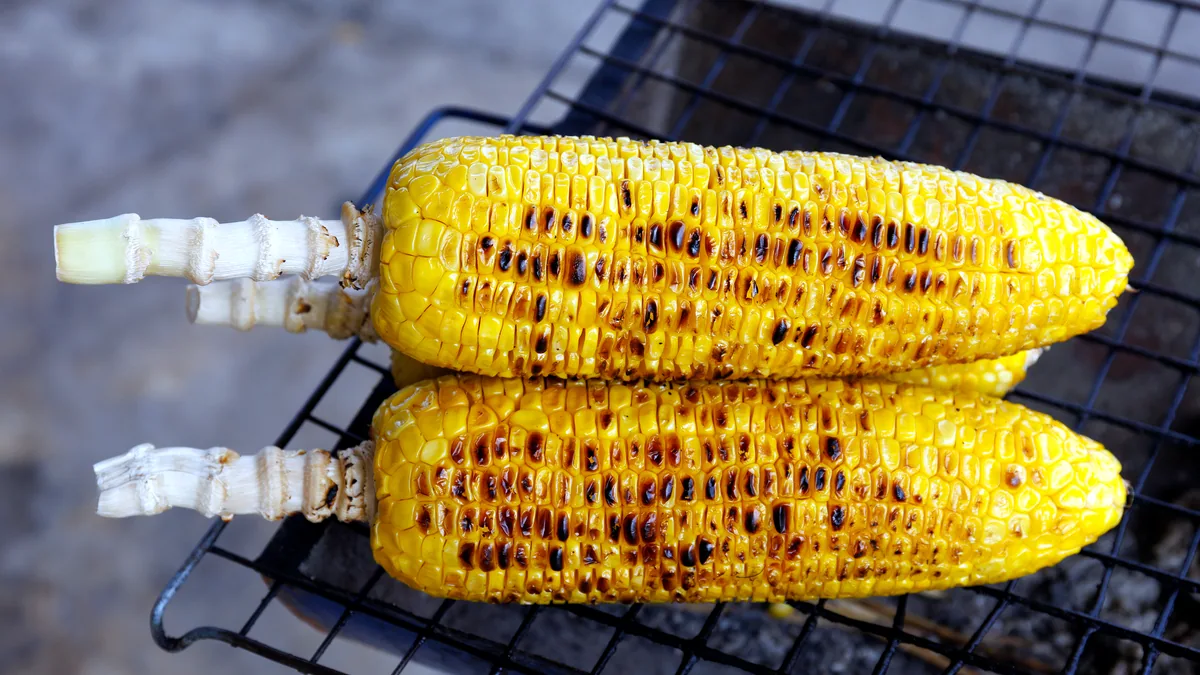
To grill corn on the cob, preheat a gas or charcoal grill to 230 C (450 F), peel back the husk to within 5 cm (2 in) of the tip, and remove the silk. Place the ear directly over the flame, rotate every 2 minutes with tongs, and cook for a total of 8 to 10 minutes until the kernels show a 2 to 3 mm char and the husk peels away easily. The husk acts as an insulating sleeve that steams the kernels while the exposed tip chars, giving the cob a layered flavour: smoky on the outside, moist on the inside. Brush the ear with 10 ml (2 tsp) of melted butter or olive oil at the 4 minute mark to promote even browning. A cast iron skillet works as a substitute grill at home: set it to 220 C (430 F) on a stovetop, lay the ear across the grates, and follow the same 8 minute schedule, rotating at 2 minute intervals.
Boiling corn on the cob in salted water
To boil corn on the cob, bring 4 litres (1.6 US gallons) of water to a rolling boil in a pot deep enough to submerge 3 ears without crowding, add 15 g (3 tsp) of coarse salt, and lower the shucked ears in with a slotted spoon. Cook for 7 minutes, then test one kernel with the tip of a knife: it should pierce cleanly and release a milky, starchy juice. Overcooking past 12 minutes turns the starches to a dense, pasty gel and the cob releases a faint sour note. For a 20 minute soak that deepens the sweetness, lower the heat to a simmer (90 C / 195 F) after the initial 7 minute boil. A corn thermometer reading of 85 C (185 F) at the thickest kernel confirms the starch has fully converted. Drain, roll in butter or a spice rub, and serve within 5 minutes of the pot, because the kernels cool and firm up rapidly once they leave the 100 C water.
Cooking an ear of corn in the microwave
To cook an ear of corn in the microwave, leave the husk and silk intact, wrap the ear loosely in 2 layers of paper towel, and place it on a microwave-safe plate. Microwave on high (1,000 W) for 3 minutes for 1 ear, 5 minutes for 2 ears, and 7 minutes for 3 ears, pausing once to rotate the ear 180 degrees. Let the corn rest in the closed microwave for 2 minutes so the trapped steam finishes cooking the innermost kernels, which sit 2 to 3 cm (1 in) from the outer layer and need the residual 95 C (203 F) heat to finish. The silk comes off in a single strip, and the husk peels back to reveal kernels that are tender and slightly less caramelised than the grilled version, since the 2.45 GHz field heats the water in each kernel rather than the surface. This method uses roughly 150 W of sustained power compared to the 2,000 W of a gas grill, so the energy cost is a fraction, and the 4 to 7 minute total time makes it the fastest route to a hot ear when the grill or pot is not available.
Choosing the right ear and trimming for cook time
Choose a corn ear by feel and weight: a good cob weighs 180 to 250 g (6 to 9 oz), the kernels pop back when pressed and release a clear, milky liquid rather than a dark, starchy one, and the husk is bright green with no brown or black spots at the tip. Trim the silk to within 2 cm (1 in) of the kernel face before grilling so the flame does not scorch the silk and transfer a bitter, acrid smoke to the surface. For boiling, the silk can stay on, because the 100 C water softens it and it pulls away in one clean sheet after the 7 minute cook. A frozen ear, picked and flash-frozen within 48 hours of harvest, needs the same 7 minutes in boiling water but benefits from an extra 2 minutes because the 18 C (0 F) frozen core takes longer to reach the 85 C starch-gelatinisation threshold than a fresh ear at 15 C (59 F).
Seasoning and serving the cooked cob
Season the corn while the kernels are still hot at 80 C (176 F) or above, because the fat in butter or oil spreads evenly across the kernel surface only above 60 C (140 F), below which it pools and sours. A 10 g (2 tsp) pat of unsalted butter, a 2 g (1/2 tsp) pinch of flaky sea salt, and 5 ml (1 tsp) of lemon zest is the baseline. For a grilled ear, add 3 g (3/4 tsp) of smoked paprika and 1 g (1/4 tsp) of garlic powder to the butter before rolling. Serve the cob on a board with a small bowl of 50 ml (2 fl oz) of the same melted butter for a second dip, and finish with a 2 g (1/2 tsp) squeeze of fresh lime juice for a bright, acidic counterpoint to the char. The cob is best eaten within 10 minutes of cooking, after which the starch retrogrades, the kernel firmness increases by an estimated 20%, and the butter congeals into a waxy film that masks the sweetness.