Beef Cuts from Tomahawk to Ribeye | The Game Larder
Beef Cuts
Cuts of steak are the individual muscle groups and primal sections of a beef carcass, of which the UK butcher's chart lists 28 named divisions, from the 3 kg rib section down to the 150 g knuckle, each carrying its own fat marbling, connective tissue and ideal cooking temperature. Reading that chart is the whole skill: every label on a pack or a board traces back to where the muscle sat on the animal and how hard that muscle worked. The Cuts guide on this site maps each name to its position, and the Best Cuts of Beef for Steaks ranking turns that map into a buying order, so the two work as a pair when you are standing in the shop. For the wider method, the Cooking Species, Cuts and Preparation section explains why the same muscle cooks differently once it leaves the bone and hits the pan.
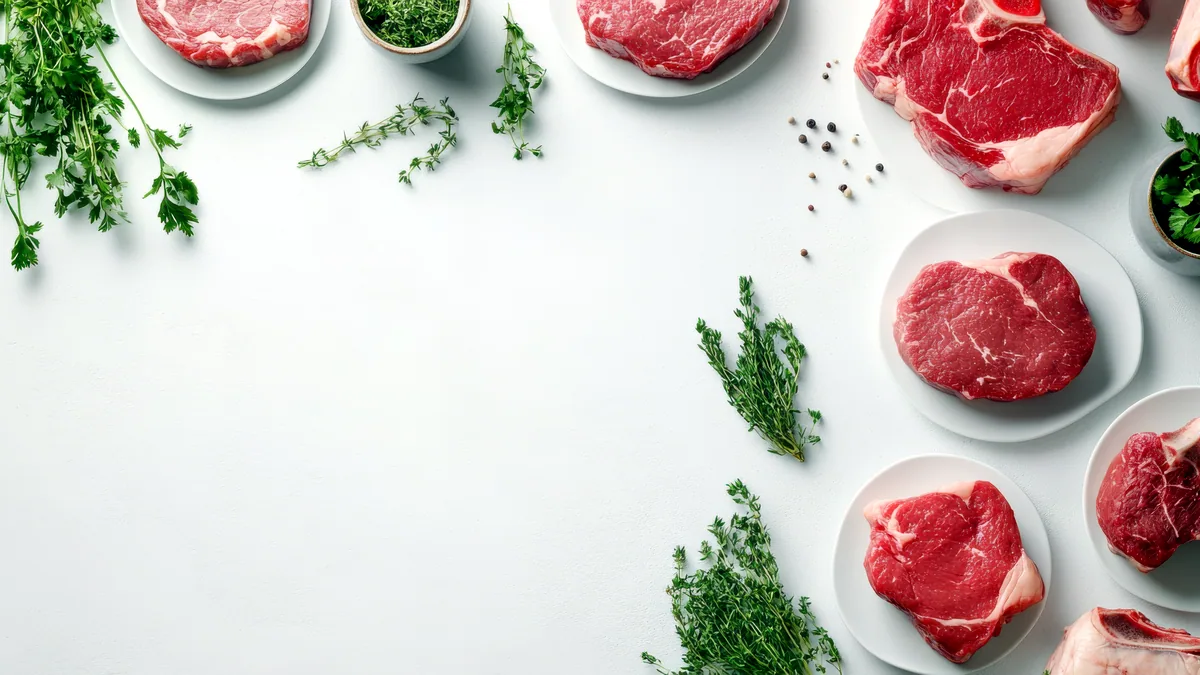
Where each cut sits on the animal
The position of a cut on the animal decides everything that follows, because a muscle that carries the animal's weight for 18 months packs the dense, tough connective tissue that only low heat can loosen, while a muscle near the shoulder that barely flexes stays loose and marbled. The carcass splits into the forequarter, the midsection and the hindquarter, and each of those yields the steaks a UK butcher will recognise.
| Primal section | Position on the animal | Steaks it yields |
|---|---|---|
| Chuck (forequarter) | Neck and shoulder | Shoulder, blade, flat iron |
| Rib (midsection) | Ribs 6 to 12 | Ribeye, rib steak |
| Loin (midsection) | Small of the back | T-bone, porterhouse, fillet, top and bottom sirloin |
| Short loin | Between rib and loin | T-bone, porterhouse |
| Sirloin (midsection) | Rump end of the loin | Sirloin, rump |
| Round (hindquarter) | Leg and thigh | Rump, silverside, topside |
| Flank | Abdominal side | Flank steak, skirt |
| Brisket | Chest | Flap |
Worked muscles such as the chuck and the round need 12 hours or more of slow cooking to break down their collagen, which is why the butcher steers you toward the rib and loin for a pan or a grill. That split is the hinge on which the ranking in the next section turns.
Best cuts of steak, ranked
The best cuts of steak, ranked by the ratio of marbling to working fibre, put the ribeye at the top and the flank at the bottom of the fast-cook list, and the order holds whether you are grilling, pan-searing or finishing under a grill at home. A cook who wants a consistent result at 55 C internal temperature has far more room to err over a ribeye than over a silverside.
- Ribeye, the 120 g to 250 g rib-end steak with a cap of the spinalis muscle and heavy internal marbling
- Tomahawk, the same ribeye with the full 15 cm rib bone left in
- Topside, a lean hindquarter steak that stays tender to 55 C
- Rump, the UK pub classic that sits just behind the sirloin
- Sirloin, the thicker rump-end loin steak cut at 2.5 cm
- Fillet, the most tender muscle in the carcass and the least fat
- T-bone, the short-loin steak that joins the fillet to the sirloin over the bone
- Porterhouse, the rib-side version of the t-bone with a larger fillet
- Flank, the 400 g abdominal steak for quick high-heat cooking
- Silverside, the lean leg cut that rewards a slow, low grill
The ranking moves the moment you change the heat, which is exactly the point the grilling section makes next.
Best cuts for grilling
The best cuts for grilling are the thick, marbled steaks that tolerate a 230 C charcoal or gas heat without drying out, and that is a short list in a UK shop. Three of them do the job reliably.
- Ribeye, with its fat cap that bastes the steak as the surface sears
- Tomahawk, which needs 6 minutes per side on a hot grate plus a 10 minute rest off the heat
- Sirloin, cut at 2.5 cm so the centre reaches 55 C before the outside burns
Leaner cuts such as the fillet and the silverside burn faster than they brown, so they belong in a pan with butter more often than on the grate. The bone on a tomahawk is the real reason it grills so well: it holds heat and keeps the fillet side from overcooking by 3 to 4 minutes, which is the whole margin of error on a 230 C grill.
Reading a UK butcher label
Reading a UK butcher label is a matter of matching the name on the pack to one of the 28 divisions on the British Standard meat chart, and four words do most of the work. "On the bone" means the steak kept its rib or its vertebra, "off the bone" means the butcher trimmed it clean, and the thickness in millimetres tells you whether the cut is made for a 3 minute sear or a 20 minute pan. A label that reads "aged 21 days" tells you the butcher dry-aged the carcass for 3 weeks to deepen the flavour, and one that reads "grass-fed" tells you the animal's feed rather than the cut itself.
Keep the four words in order and you can decode any label in the shop: position, bone, thickness, then ageing. Once the label is readable, the last question is which cut you actually buy for the meal in front of you.
Choosing the right cut for the meal
Choosing the right cut for the meal comes down to matching the cook's heat and time to the muscle, so the steak finishes tender rather than tough. The rule is simple once you know the position on the animal from the table above: fast heat for the working muscles, slow heat for the weight bearers, and the rib and loin sit comfortably in between.
- Grill a ribeye or a tomahawk at 230 C for 6 minutes per side
- Sear a sirloin in a cast-iron pan for 4 minutes per side at 2.5 cm
- Pan a fillet at 55 C internal for 3 minutes per side and rest for 5
- Cook a flank at full heat for 2 minutes per side and slice across the grain
- Slow-cook a chuck or a silverside at 90 C for 12 hours to turn collagen to gelatin
The cut you buy should match the heat you have, the time you have, and the number of people at the table, and once those three lines up, the label on the pack is just a map of where the steak came from. That is all a butcher's chart asks you to carry: one muscle, one position, one method, and the numbers that keep it tender.